Why object handling breaks down with “hand-only” robots
In a demo, an arm-and-gripper robot can pick up a clean box from a known spot all day. On an actual floor, the same task drifts: cartons bulge, tape edges catch, totes arrive skewed, and the “right” grasp point disappears. When the only contact is at the fingertips, small pose errors turn into big forces, and the object starts to rotate or slide. The robot then has few options besides regrasping, slowing down, or stopping.
Hand-only systems also run out of stability margin fast. If the load is off-center, heavier than expected, or bumps a shelf, the wrist and fingers must absorb the shock while maintaining friction. That is hard to do without compliant surfaces, high-quality sensing, and very tight control loops. Those upgrades raise cost and integration time, and they still don’t solve the basic problem: when the grasp is the only support, any slip becomes a likely drop.
Even “good” grippers struggle with variance because they are asked to do two jobs at once: position the object and stabilize it. Humans rarely do that with fingers alone; they use the body to pin, guide, and buffer. Without those extra contacts, arm-only robots become brittle to normal clutter—objects touching each other, crowded bins, and partial occlusions—where perception can’t reliably tell what’s safe to grab and what will snag.
What “whole-body” means in practice, not in marketing
Whole-body manipulation is less about adding “more joints” and more about using the robot’s full structure as part of the handling plan. The arms still grasp, but the torso shifts to keep the load over the support polygon, the base repositions to change approach angle, and the legs (or mobile platform) adjust stance to maintain balance during contact. The key difference is that the robot can create and manage multiple contacts—hand plus forearm, object plus torso, object plus shelf edge—so the grasp is no longer the only thing preventing a slip.
In practice, this shows up in mundane moves: nudging a carton square against a stop before lifting, pulling a tote closer by hooking it with an elbow, or briefly “parking” an object against the chest while the other hand regrips. It also enables recovery: if an item starts to rotate, the robot can step, lean, or brace instead of freezing. These behaviors require space, predictable floor friction, and conservative force limits around people, which can reduce throughput and raise integration cost even when the robot looks capable in a lab.
Using the torso and legs to make grasps reliable
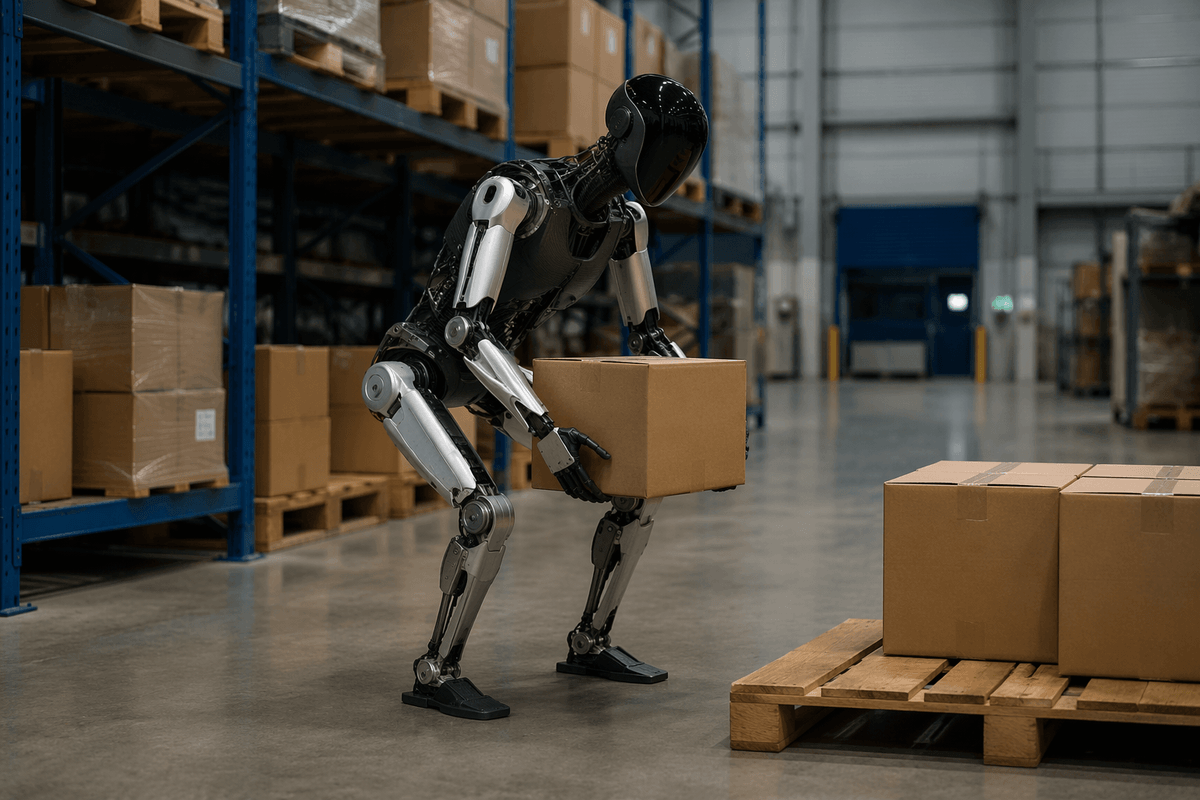
A common floor problem is a grab that “should” work but doesn’t: a carton lifts, twists a few degrees, and the gripper loses its friction margin. Whole-body robots treat that as a balance and contact problem, not just a finger problem. Before the lift, the torso can shift so the object’s center of mass stays closer to the robot’s midline, reducing wrist torque that pries the grasp open. The base or legs can step to get a straighter pull, so the first motion is up rather than up-and-out, which is where boxes tend to slip.
During the move, the torso and legs also act like a shock absorber. If the load bumps a rack upright or catches on a lip, a whole-body controller can yield through the hips and knees while keeping the object supported, instead of forcing the gripper to take the entire impulse. That said, these “make it stable” moves consume time and floorspace, and they depend on reliable traction; a dusty or uneven floor can limit how aggressively the robot can lean or step without increasing tip risk.
When leaning, bracing, and pushing beat precise finger control
Watch how people handle awkward items in tight spaces: they don’t “solve” every pose with fingertip precision. They lean a box into their hip to stop it yawing, brace a tote against a shelf edge to free one hand, or push an object along a surface until it’s aligned. Those moves turn a fragile pinch grasp into a stable, multi-contact situation where friction and geometry do more of the work than grip force.
Whole-body robots can use the same logic. If a carton is slightly crushed, a controller can press it gently into a known plane (a table, a stop, the robot’s forearm) to square it before lifting. If an item is too wide for a confident grasp, the robot can “walk” it into position with short pushes, then capture it with a simpler hold. This often beats chasing perfect finger placement under messy perception because pushing and bracing are tolerant to small errors.
The contact-rich handling demands controlled surroundings: sturdy fixtures to brace against, surfaces that won’t get damaged, and conservative force limits around people. It can also be slower, since the robot may need extra micro-motions to confirm that the object is truly supported before committing to a lift.
Control and perception constraints that decide what’s feasible
On a real line, the hard part often isn’t “can it lift?” but “does it know what’s happening while it’s touching things?” The moment a robot leans, braces, or slides an object, vision gets partially blocked by its own arms and the object itself. Depth cameras lose edges on shiny tape and black plastic, and small calibration drift between camera, gripper, and base shows up as contact in the wrong place.
Whole-body handling also stresses control timing. Contact-rich moves need fast, stable force control so the robot can push lightly, feel a stop, and back off before crushing a carton or tipping a stack. If the force sensors are noisy, the control loop is slow, or the controller assumes the wrong friction, the robot “chatters,” stalls, or compensates with overly cautious motions that cut throughput.
These constraints drive practical design choices: more conservative speeds around people, more structured fixtures to push against, and more commissioning time to tune force limits per SKU type. The capability is real, but it’s bounded by sensing quality, latency, and how repeatable the environment is day to day.
Safety, speed, and floorspace: the real-world tradeoffs
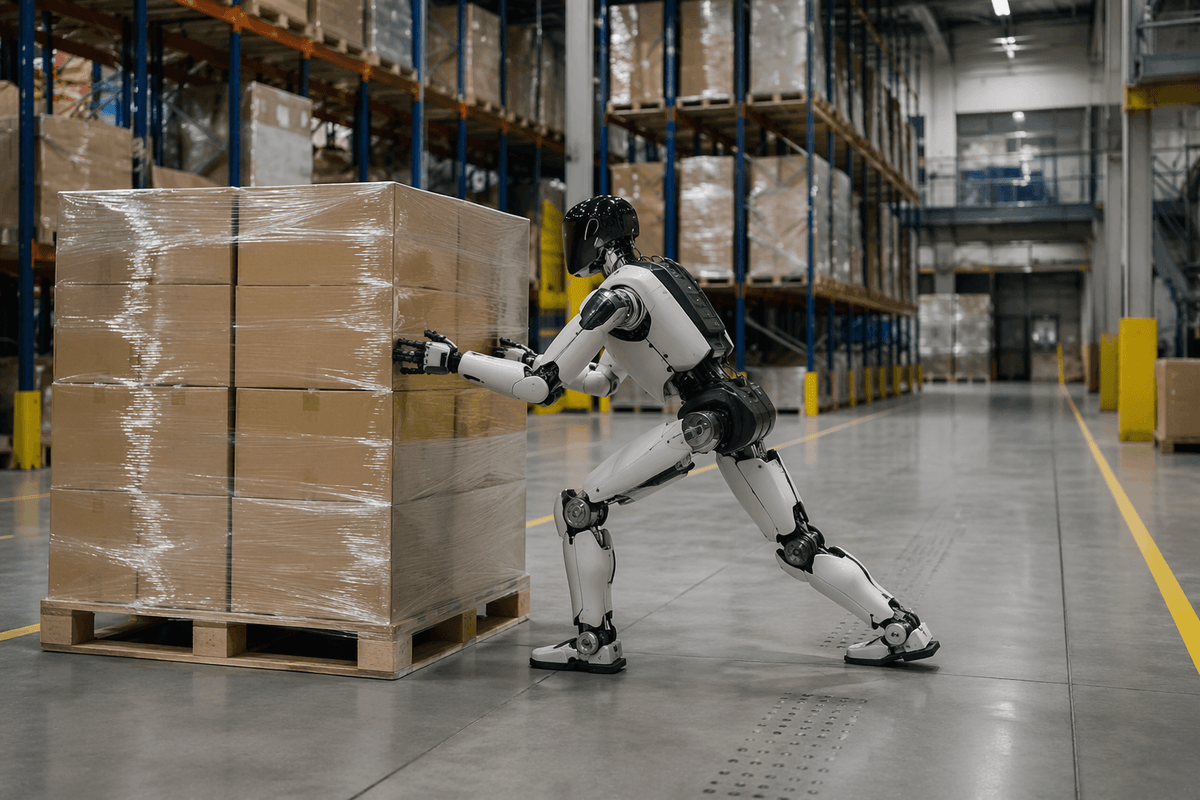
In a facility, the biggest difference you feel from whole-body handling is that “using the body” usually means taking up room. A robot that steps, widens stance, or swings a torso to keep a load stable needs clear aisles and predictable zones, not the tight, shared spaces many sites rely on. You may regain reliability on awkward picks, but lose density: fewer pallets staged in reach, wider buffers around racks, and more attention to floor condition so traction stays consistent.
Safety pushes in the same direction. Leaning and bracing can be gentle and controlled, but the robot’s effective swept volume grows, and the safest settings limit contact force and speed near people. That often means slower cycle times, more fencing or well-marked “robot lanes,” and more interlocks that pause motion when someone enters a zone. The tradeoff is straightforward: higher success rates and fewer drops, paid for with floorspace, throughput headroom, and a more structured operating area.
How to evaluate whole-body robots for your handling tasks
If you’re deciding whether “whole-body” matters for your workflow, start with your failure cases: crushed cartons, off-center loads, tight rack picks, and any move where today’s robot drops or stalls after contact. Ask vendors to run those exact scenarios, not idealized picks, and watch for recovery behaviors—stepping, re-centering the torso, bracing on a fixture—without operator resets.
Then evaluate integration realities. You’ll need stable floors, known bracing surfaces, and space for widened stances and larger swept volumes. Check force limits and safety modes in your actual traffic patterns, because conservative settings can erase throughput gains. Finally, score reliability by “interventions per shift,” not best-cycle time, and price in commissioning time for force tuning across your SKU mix.