Why “secure workloads” need privacy-preserving AI now
A familiar pattern keeps repeating: an AI pilot works on sanitized data in a controlled lab, then stalls when it touches real customer records, payment data, PHI, source code, or regulated logs. “Secure” usually means storage encryption, network controls, and access reviews, but modern AI expands the attack surface: prompts can leak context, training can memorize rare strings, and inference often runs in shared infrastructure you don’t fully control.
Privacy-preserving AI exists because the old boundary—keep data inside a trusted perimeter—no longer matches how workloads ship. Cloud acceleration, third-party models, and cross-team reuse create pressure to move faster than governance can approve.
The stronger protections can add latency, cost, and operational complexity. The goal is not maximal secrecy; it’s matching safeguards to the specific ways data and models can be exposed while still delivering usable throughput.
Map your real exposure points: data, model, and runtime
Most teams start by asking, “Where is the sensitive data?” but the better question is, “Where can it escape?” Map exposure across three layers: data, model, and runtime. For data, include not just tables and files, but prompts, retrieved documents (RAG), feature stores, embeddings, caches, and logs. Pay attention to who can see plaintext during preprocessing, vectorization, and inference—especially in shared analytics platforms where “admin” often implies broad visibility.
For the model layer, treat weights, gradients, and fine-tuning datasets as assets with their own leakage paths. A hosted model can retain or regurgitate rare strings; a tuned model can encode proprietary patterns; model artifacts in object storage can be copied like any other file. Also map who can export checkpoints, view training metrics, or run shadow evaluations.
For runtime, assume the busiest leak points are operational: telemetry, traces, error dumps, GPU memory, swap, and support access. Tightening these controls can slow debugging and raise cloud costs, so document which visibility you truly need for reliability—and which is just habit.
Choose the right tool: TEEs, HE, FL, DP, MPC
A common decision point is whether you need to protect data from the cloud operator and platform admins, or only from other applications and users. Trusted Execution Environments (TEEs) protect data “in use” by running code inside a hardware-backed enclave; they’re often the fastest path to production for inference and some ETL, but they add attestation steps, operational constraints, and a new class of side-channel and patch-management work.
Homomorphic Encryption (HE) keeps data encrypted while computing, which is attractive when you cannot allow plaintext anywhere, but it can be slow and limits which model operations are practical. Secure Multi-Party Computation (MPC) splits secrets across parties so no single party sees the full input; it works well for joint analytics across organizations, yet it adds coordination overhead and can amplify latency.
Federated Learning (FL) reduces central data pooling by training where data lives, while Differential Privacy (DP) intentionally adds noise to reduce what models or reports reveal about individuals. FL still needs strong controls on updates and aggregation, and DP forces an accuracy budget. Ask vendors what threats they cover, what they don’t, and what performance you should expect at your target scale.
Speed vs. privacy: what performance tradeoffs look like
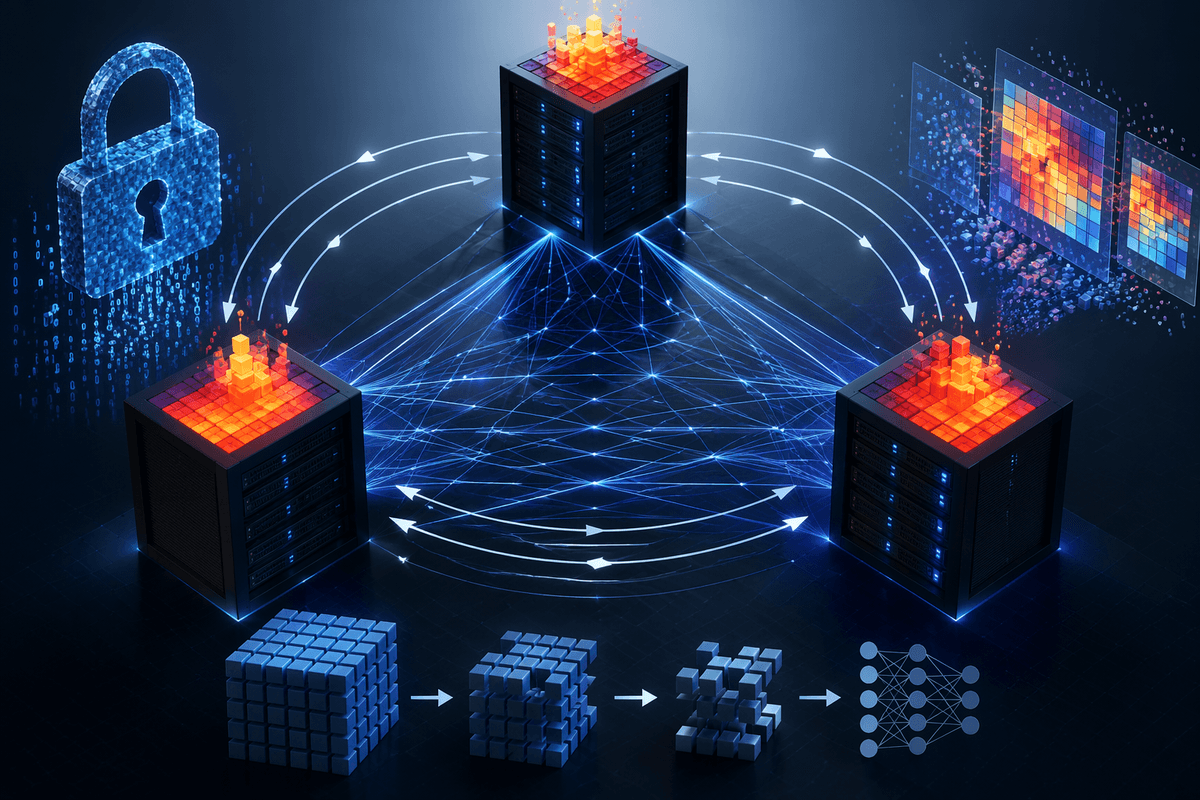
Teams feel the tradeoff most acutely when a prototype moves from “one analyst, one dataset” to batch pipelines and interactive inference. A TEE deployment can look close to native speed on some inference paths, but startup, attestation, memory limits, and enclave I/O patterns can push you to smaller batch sizes and different caching choices. If your model relies on large context windows or heavyweight retrieval, the constraint is often not raw compute, but how much plaintext observability you give up for debugging and performance tuning.
HE and MPC shift the curve further: you’re buying confidentiality with more compute and more round trips. Expect narrower model choices (or approximations), slower feature engineering, and fewer “free” optimizations like vectorized kernels. FL can keep throughput high locally, but adds coordination cost: client availability, straggler handling, and more complex failure modes. DP is usually cheap to run, but expensive in utility; the privacy budget you can defend to regulators may force fewer features, coarser outputs, or lower accuracy.
Make vendors show the slowdown on your workload shape: batch size, sequence length, retrieval fan-out, and end-to-end latency. The meaningful metric is not “percent overhead,” but whether your SLOs, cost envelope, and incident response expectations still hold.
Secure workload patterns that actually ship in production
A pattern that ships is “confidential inference”: keep the model stable, run it inside a TEE, and treat prompts, retrieved passages, and outputs as sensitive streams. In practice this pairs well with a gateway that redacts obvious identifiers, a RAG store with per-tenant keys, and logging that records hashes, not payloads. The limitation is operational: enclave memory ceilings and constrained debugging mean you often need extra synthetic test harnesses and stricter change control to maintain reliability.
Another common pattern is “privacy boundary at training time.” Many teams avoid fine-tuning on raw records and instead do feature extraction in a controlled zone, then train on minimized or pseudonymized datasets, adding DP only to the final aggregates or evaluation reports. Where data can’t move at all, FL tends to work best for narrow, well-instrumented models (risk scoring, anomaly detection) rather than large generative tuning, because client updates, drift, and rollback procedures become the real cost center.
Cross-organization analytics usually lands on MPC or HE only for specific joins, counting, or eligibility checks, then hands off to conventional systems for the rest. Keeping the “encrypted” part small is often what makes the program deliverable on time.
Compliance, governance, and auditability without blocking delivery

When a workload moves into regulated data, delivery often slows less because of encryption choices and more because no one can explain—clearly and repeatably—who accessed what, when, under which controls. Treat privacy-preserving AI as part of your control stack: define data classifications for prompts, retrieved context, embeddings, and outputs; set explicit retention limits; and align each path to a policy that maps to SOC 2/ISO 27001 evidence or HIPAA/GDPR expectations.
Make auditability a product feature of the platform. Require attestation logs for enclave-based runs, signed model artifacts with provenance (training data version, code commit, approvals), and immutable access logs for retrieval stores and feature pipelines. Expect friction: reduced payload logging complicates incident response, and tighter change control can slow model iteration. Compensate with synthetic replay datasets, structured redaction rules, and pre-approved “safe telemetry” schemas so engineers can debug without reintroducing plaintext leakage.
Vendor conversations should end with artifacts, not promises: threat model, shared responsibility, audit report scope, and which controls are configurable versus fixed. If they can’t show how your auditors will validate controls for training and inference separately, you’re buying future delivery delays.
A practical adoption plan: start small, then scale safely
A practical rollout starts with one bounded use case: confidential inference on a stable model, with sensitive inputs coming from a single system of record. Define success as measurable risk reduction plus an SLO you can actually operate (latency, cost per request, and incident response time). Build the minimum control set: classification for prompts/RAG context, key management, and an evidence trail (attestation or access logs) that an auditor can replay.
Expand only after you can patch, rotate keys, and reproduce failures without raw payload logs. Add complexity one dimension at a time: more tenants, more retrieval sources, then training. Budget for the real costs—enclave memory limits, slower debugging, and extra test data generation—and require vendors to prove performance on your workload shape, not a benchmark.