Why “learning chemical rules” matters beyond prediction scores
A model can post a strong test score on a property prediction benchmark while still “cheating” in ways that don’t help real chemistry. If training data contains easy cues—certain substructures that correlate with activity because of how the dataset was assembled—the model may learn those correlations without learning constraints that make molecules physically plausible. That difference matters the moment you ask it to propose new molecules, to extrapolate to a new series, or to run in a workflow where invalid structures waste days of synthesis planning.
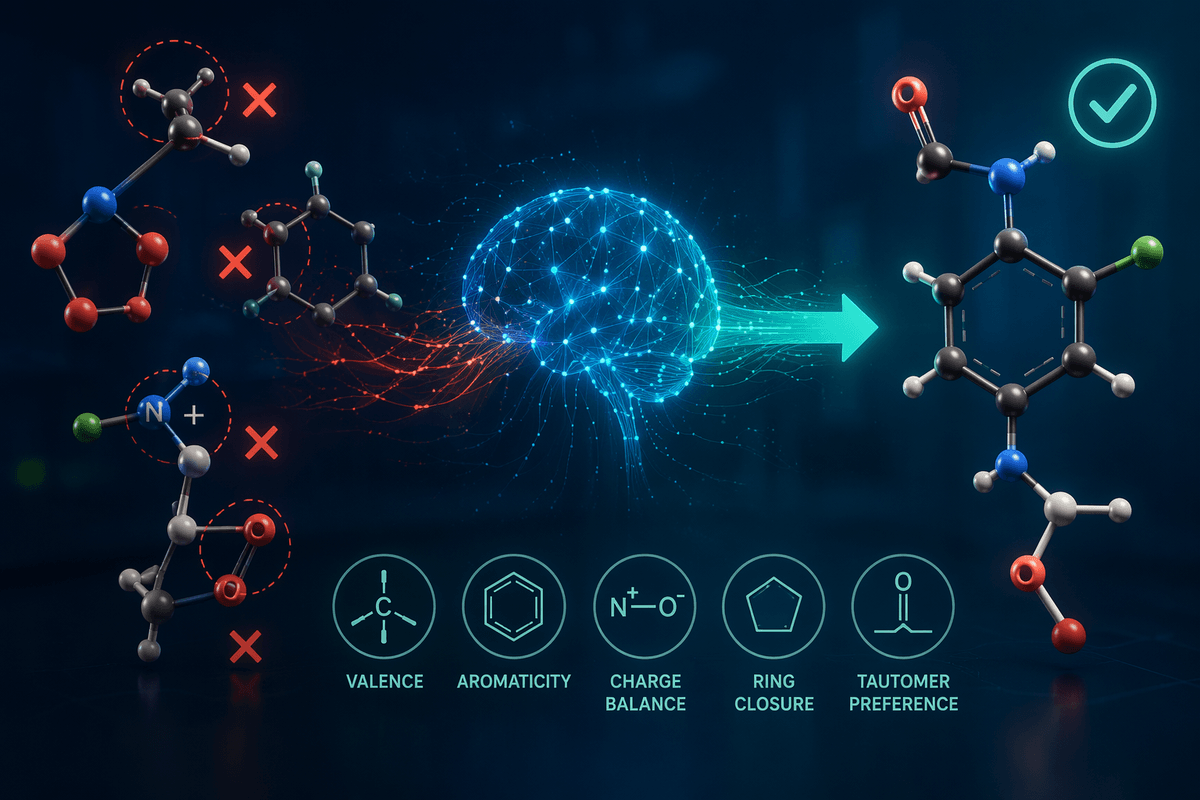
Learning chemical structure rules means the model respects basics like valence, aromaticity, and reasonable bonding patterns even when it’s pushed outside familiar examples. That tends to show up as fewer impossible suggestions, more stable behavior under small edits, and predictions that degrade gracefully instead of failing loudly. It isn’t free: enforcing or learning these constraints can reduce apparent benchmark scores, add compute, or require extra checks, but it buys reliability where discovery work is expensive.
What counts as a chemical structure rule in practice
In practice, a “chemical structure rule” is any constraint that limits which graphs of atoms and bonds can correspond to a real, isolable molecule. Some rules are local and mechanical: carbon rarely exceeds four single bonds; oxygen typically makes two; charged atoms need the right electron-counting; ring closures can’t create impossible bond angles. Others are pattern-based: aromatic rings follow specific electron and bond arrangements; amides prefer certain resonance-stabilized connectivity; some tautomers are far more common than others under typical conditions.
These rules aren’t always written into the model as hard constraints. Often they emerge as high-probability regularities because the training set mostly contains “chemically sane” structures. The datasets underrepresent unstable intermediates, unusual valence states, or strained motifs, so a model may treat them as impossible rather than rare—until a real project needs exactly that edge case.
How molecules are represented shapes what a model can learn
Picture two teams building the same model, but feeding it molecules in different “languages.” One uses SMILES strings, where the model predicts the next character. The other uses graphs, where atoms are nodes and bonds are edges. A third uses 3D coordinates, where geometry and distances are explicit. Each choice quietly sets what’s easy to learn: SMILES makes syntax errors and invalid ring closures a constant risk, while graphs make valence and connectivity more natural but still leave stereochemistry and conformations implicit unless you add them.
Representation also shapes generalization. If the same molecule can be written many ways (as with SMILES), the model may spend capacity learning the writing style rather than chemistry unless you canonicalize or augment. Graph models avoid that redundancy, but they can still miss long-range effects like steric crowding without 3D signals. Adding 3D helps, yet it raises cost: you need conformers, alignment choices, and more compute, and you can still be wrong if the relevant bioactive shape differs from the one you generated.
Where the “rules” come from: data, supervision, and inductive bias
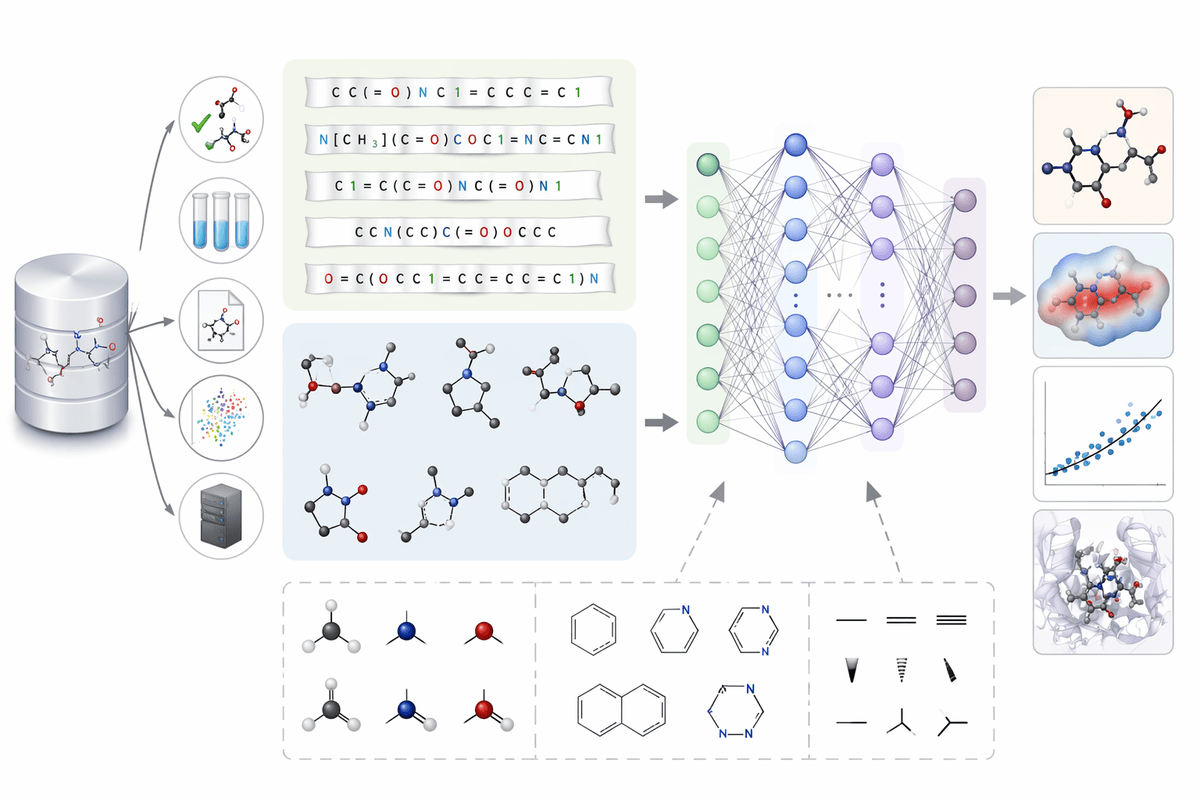
In a typical pipeline, “rules” first come from what the model sees most often: curated databases skew toward stable, characterizable compounds, so the model treats common valences and bonding patterns as default. If you train on SMILES, it also learns the writing constraints of SMILES—bracket syntax, ring indices, aromatic tokens—which can look like chemistry but is partly grammar. With graphs, the same pressure shows up as statistical preferences over bond orders and atom types, reinforced by how the dataset encodes charges, aromaticity flags, and stereochemistry.
Supervision then sharpens those preferences. When the target is a property label, the model may only learn chemistry that helps the label, ignoring rare-but-valid motifs. When the target is reconstruction (masked atoms/bonds) or next-step generation, it gets more direct feedback on “what a molecule can be,” but only within the distribution it was trained on. Inductive bias matters because it’s the model’s built-in nudge: graph architectures naturally respect permutation invariance, and valence-aware decoders or validity filters can prevent obvious nonsense—at the cost of extra engineering and sometimes lower apparent novelty.
Signals that the model truly learned rules (not shortcuts)
A familiar red flag is when tiny, chemically irrelevant edits swing a prediction wildly. A better sign is local stability: replace a methyl with an ethyl, move a halogen around a ring, or swap an isostere, and the model changes its output in a way that tracks medicinal-chemistry intuition rather than dataset quirks. Another signal is consistency across equivalent inputs. If different SMILES for the same molecule produce noticeably different answers, the model may be leaning on string patterns instead of structure.
For generators, validity is necessary but not sufficient. If most outputs satisfy valence, aromaticity, and charge balance without heavy post-filtering, that suggests the model internalized constraints rather than being rescued by a rules engine. Stronger evidence comes from controlled stress tests: ask for structures with uncommon atoms, strained rings, or tautomer-sensitive motifs and check whether it fails gracefully (lower confidence, conservative proposals) instead of producing confident nonsense. These tests require curated challenge sets and cheminformatics checks, not just another benchmark leaderboard.
Common failure modes: invalid molecules, weird chemistry, overconfident answers
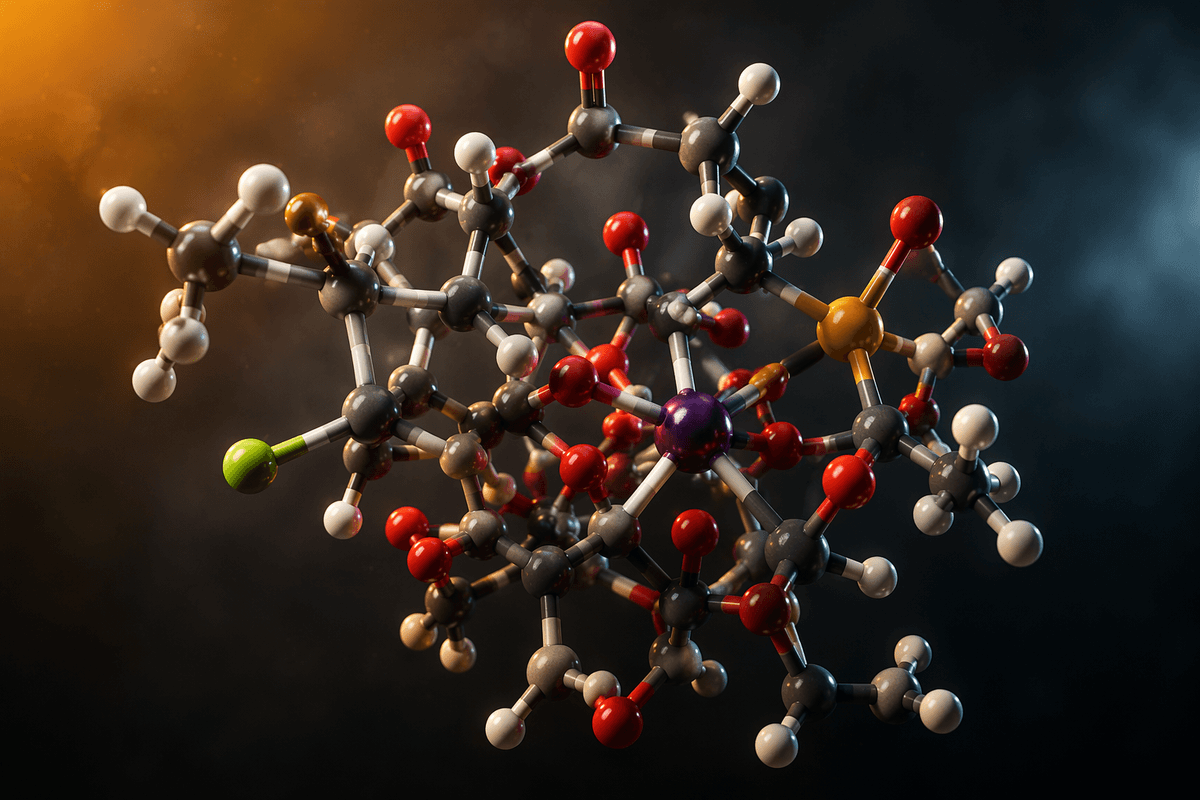
A common disappointment shows up the first time you sample a thousand “novel” molecules and realize a large chunk can’t even be parsed, or collapses under basic sanitization: broken ring closures in SMILES, impossible valences, aromatic systems that don’t meet electron-count rules, or charge patterns that imply wildly unstable species. Graph decoders reduce pure syntax failures, but they still invent odd bond orders or miss stereochemical consistency, so the structure may be “valid” in a file format while being chemically dubious.
Even when structures pass checks, models can drift into weird chemistry: strained polycycles with no clear reason, reactive functional groups stacked together, or motifs that exploit dataset gaps (for example, rare atoms paired with unlikely neighbors). These failures often come with overconfident property predictions, because the model’s uncertainty is tied to training frequency, not real-world synthesizability. The practical cost is screening time: every invalid or implausible proposal consumes compute, analyst attention, and downstream planning before anyone learns it was never a realistic candidate.
Practical patterns that improve chemical validity and usefulness
You see the difference in practice when you try to sample at scale: the raw model might generate a few great candidates, but it also produces a long tail of structures that waste triage time. A reliable pattern is to bake validity into the generation step, not only as an after-the-fact filter. Valence-aware graph decoders, constrained tokenization for SMILES, and “sanitize-as-you-build” checks (ring closure, aromaticity, charge balance) reduce the number of dead-on-arrival molecules before you spend compute scoring them.
Usefulness improves when you couple chemical checks to the objective, not just to cleanup. Simple multi-objective constraints—basic ADMET alerts, reactive group filters, and a synthesizability proxy—often outperform a single property target because they prevent the model from “winning” via extreme chemistry. Diversity controls help too: enforce scaffold or fingerprint diversity so you don’t get a thousand near-duplicates.
These checks add latency and engineering overhead, and some will incorrectly reject unusual-but-valid motifs, so teams usually tune them per project rather than treating them as universal rules.
A realistic takeaway: combine learned patterns with chemistry checks
You can treat “learned chemical rules” as a helpful prior, not a replacement for chemistry. Models are good at absorbing frequent patterns—typical valences, common ring systems, familiar functional-group neighborhoods—and using them to propose or score candidates quickly. They are less reliable when a program pushes into rare charge states, unusual heterocycles, strained scaffolds, or chemistry that is underrepresented in public datasets.
The workable stance is hybrid: let the model generate and prioritize, then gate results with explicit checks (sanitization, valence/aromaticity, tautomer handling, alerts, and a synthesizability screen), and track failure rates as a metric. That adds cost and can trim novelty, but it turns “plausible on paper” into a smaller set you can actually plan, order, or make.