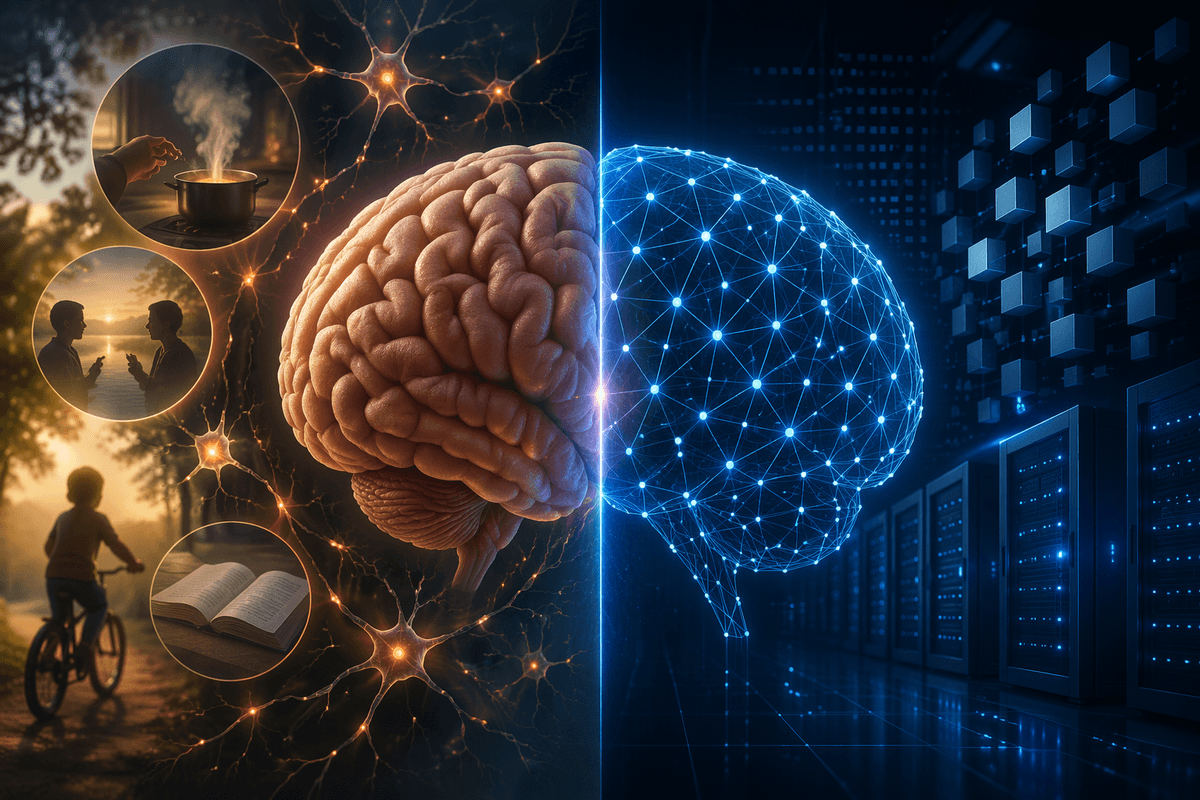
Why people say computer vision works like the brain
You’ve probably seen a demo where a model draws boxes around dogs, pedestrians, and stop signs, then someone says it “sees like we do.” The comparison feels natural because the output looks like perception: identify objects, track them across frames, and react quickly.
People also reach for the brain analogy because key ideas line up at a distance. Modern vision models often build meaning in layers, turning pixels into edges, textures, parts, and categories—similar to how biology builds progressively richer representations. Some models even use “attention” to emphasize certain regions over others.
This resemblance is mostly about structure, not experience. Models usually need huge labeled datasets, expensive training runs, and still fail on small shifts in lighting, viewpoint, or context that humans handle with little effort.
A quick map of how humans turn light into meaning
When you look at a street scene, the first “input” is just light hitting the retina, which already does some preprocessing before anything reaches the brain. Signals travel through the optic nerve to early visual cortex, where neurons respond to simple patterns like edges, orientations, and motion. From there, processing spreads across multiple pathways: one stream is more tuned to “what” something is (faces, objects), and another is more tuned to “where” it is and how it’s moving.
Meaning comes from combining these fast, partial signals with context and prior knowledge. Your brain uses expectations about typical scenes, continuity over time, and cues from other senses to resolve ambiguity—like deciding whether a dark blob is a bag or a shadow. That integration is powerful but not free: it depends on years of exposure, a body that moves, and constant feedback from action, which makes it hard to copy with a static dataset of labeled images.
Layered feature building: where CNNs genuinely echo biology
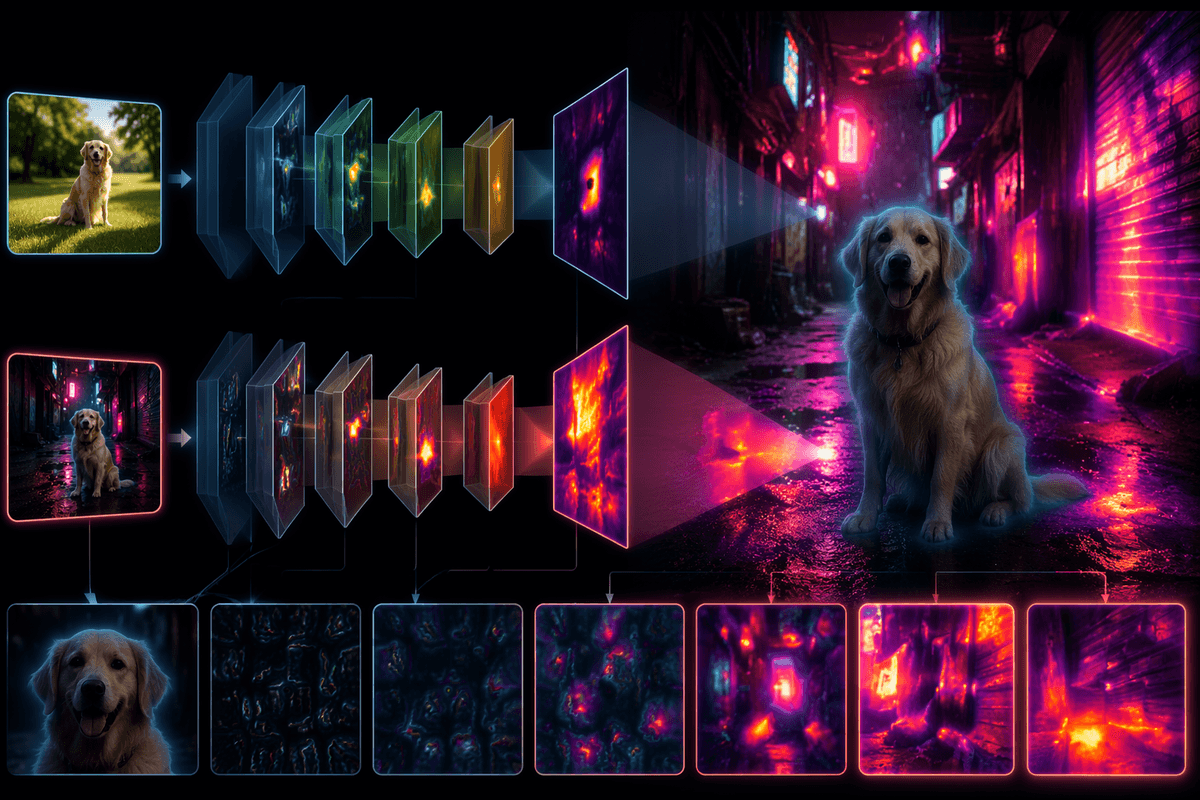
Look at the first few layers of a classic convolutional neural network (CNN) and the brain comparison becomes more than marketing. Early CNN filters often behave like edge and orientation detectors, picking up simple contrasts and strokes that are useful almost anywhere in an image. Deeper layers combine those basic signals into more specific patterns—corners, textures, repeated motifs—until later layers respond strongly to object-like parts and full categories. That “build complexity step by step” idea genuinely matches a key theme in biological vision: early areas capture simple structure, later areas support richer, more invariant descriptions.
The resemblance has limits that matter in practice. CNNs typically learn these features through backpropagation on large labeled datasets, not through the mix of self-driven exploration and multisensory feedback humans rely on. They also tend to overuse superficial cues—backgrounds, camera style, common textures—so the same layered pipeline can look competent on benchmarks yet break under distribution shifts, new environments, or unusual examples.
Attention in models versus attention in human vision
In a crowded photo, you don’t process every pixel equally. You glance at a face, then a hand holding a phone, then the crosswalk signal, guided by goals, habits, and what just happened a moment ago. Human visual attention is tightly coupled to eye movements, working memory, and task demands, and it shifts based on uncertainty (“what was that?”) as much as salience (“that’s bright”).
Model “attention” is usually a routing mechanism inside the network: a way to reweight features or let one patch of an image exchange information with another. In transformers, attention scores act more like learned connections than like a spotlight controlled by a mind. It can help integrate long-range context (a wheel helps predict a bike), but it doesn’t automatically bring human-like priorities or understanding.
Attention can be compute- and memory-heavy on high-resolution images, so systems often use approximations or smaller windows, which can miss small but critical details in real deployments.
Learning signals: labeled datasets aren’t how babies learn

Think about how a toddler learns “dog.” They don’t see 100,000 photos with the label DOG stamped underneath. They see one animal from many angles, hear the word in context, watch it move, pet it, get corrected, and connect it to other concepts (“not cat”). The learning signal is messy but constant: time, touch, sound, cause and effect, and social feedback.
Most vision models learn differently. The standard recipe is supervised learning: pairs of images and labels, optimized to reduce prediction error. That can work extremely well, but it pushes models toward shortcuts that fit the dataset—backgrounds, common poses, camera artifacts—because those cues also reduce error. It’s also expensive. High-quality labels cost time and money, and rare edge cases (odd lighting, unusual objects, near-misses) are precisely what’s hardest to label at scale.
Self-supervised and multimodal approaches narrow the gap by learning from patterns in raw data or pairing images with text, but they still lack the open-ended, embodied feedback loop that makes human learning so data-efficient.
Feedback loops, memory, and body-in-the-world constraints
Watch yourself park a car or pour coffee and you’ll notice vision isn’t a one-shot classification. You look, act, see the result, then adjust. That loop—perception shaping action and action changing what you see—lets humans recover from uncertainty. If a shape is ambiguous, you move your head, change the lighting, or get closer. Most deployed vision systems don’t get that option; they’re asked to decide from a fixed camera frame, often under latency limits that discourage “try again” behaviors.
Memory is another missing piece. People use short-term visual memory to keep track of what just happened and long-term memory to fill in what’s typical for a scene. Many models treat each image independently, or add a thin layer of temporal smoothing, which helps with tracking but doesn’t create durable, task-shaped understanding.
Embodiment also imposes constraints: eyes have limited resolution, attention is guided by goals, and learning is grounded in touch and consequence. Simulating those loops in AI usually means extra sensors, data collection, and safety testing—expensive, slow, and hard to reproduce across environments.
A practical way to use the brain analogy without overtrusting it
You’ll still hear “brain-like” in product pitches, and it can be useful if you treat it as a design metaphor, not a reliability guarantee. It’s fair to say modern vision borrows the idea of layered representations and, sometimes, attention-like routing. It’s not fair to assume human robustness, common sense, or learning efficiency comes along for free.
A practical rule is to translate the analogy into testable questions: What shifts break the model (lighting, camera, context)? Does it stay stable across locations and seasons? What happens on rare but important edge cases? Plan for the costs those tests imply—data collection, labeling, and ongoing monitoring—because “brain-inspired” doesn’t remove them.