Why image generation latency is suddenly the main bottleneck
You can usually scale text generation by streaming tokens, caching prompts, and running multiple requests in parallel. Image generation doesn’t offer the same escape hatches. A single image often requires a full burst of compute before the user sees anything useful, and the work is dominated by repeated model passes rather than I/O.
That used to be tolerable when images were a background task. Now they’re inside interactive product loops: “try another style,” “change the background,” “generate four options,” “iterate until it fits.” Multiply that by higher default resolutions and larger batches, and latency becomes the cost people feel first.
Even if your GPUs are busy in an efficient way, the practical constraint is the wall-clock gap between intent and preview. Hiding it is hard: partial previews often mislead users, aggressive batching adds queueing delay, and throwing more hardware at peak traffic can be uneconomical. When teams say images are “slow,” they usually mean this end-to-end loop time, not raw throughput.
What “one-step” really means (and what it doesn’t)
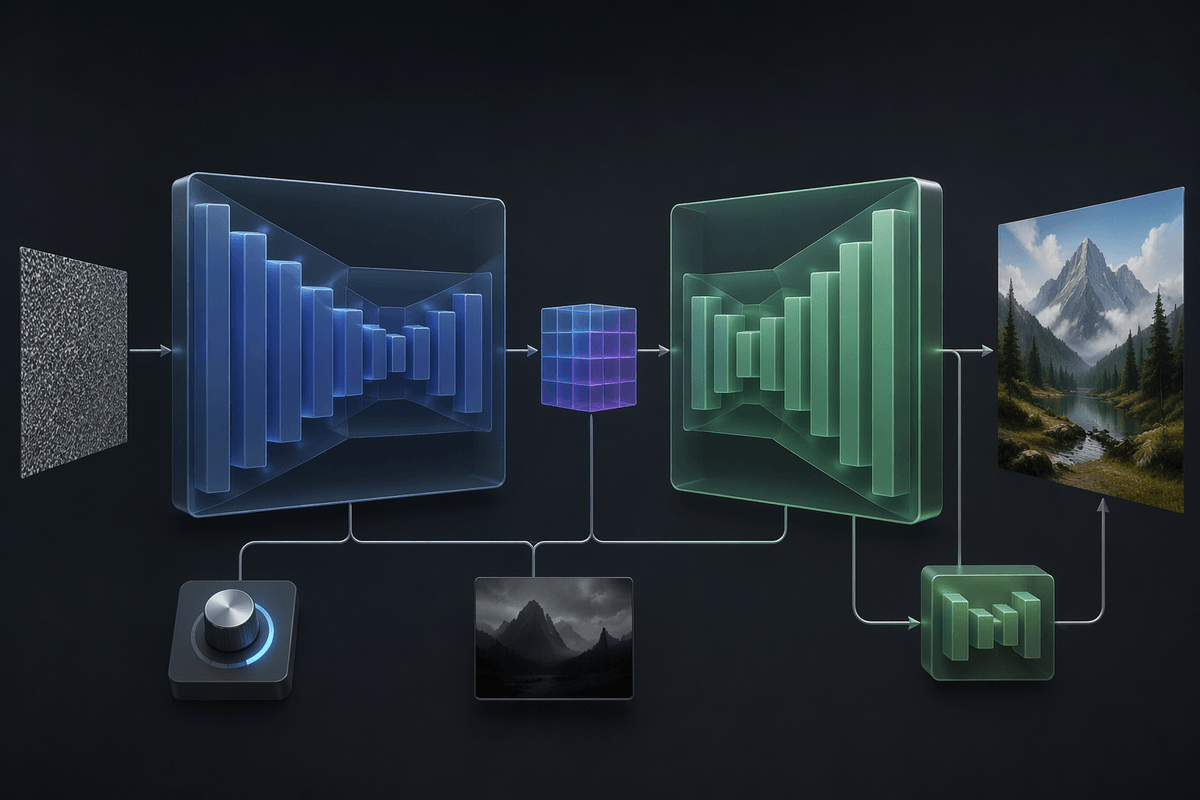
In a typical diffusion setup, the model starts from noise and takes dozens of small denoising steps, each step calling a large network again. “One-step” models aim to replace that iterative loop with a single forward pass that maps your prompt (and any conditioning like a reference image) directly to pixels or a compact latent that decodes to pixels. That’s the core meaning: one expensive pass instead of many moderately expensive passes.
It doesn’t mean “instant” or “free.” You still pay for a big model evaluation, plus decoding, safety checks, and any post-processing. It also doesn’t mean you’ve eliminated sampling choices; many systems keep optional knobs like guidance strength, negative prompts, or lightweight refiners, which quietly reintroduce extra compute. The practical promise is lower and more predictable latency, not the full range of iterative correction you get when you can steer a result across multiple steps.
Where the speedup comes from in practical deployments
The speedup shows up first as fewer serial dependencies. Multi-step diffusion forces you to run the same large network over and over, and each step depends on the previous one, so you can’t easily “parallelize your way out” of latency for a single image. One-step collapses that chain into one forward pass, which cuts wall-clock time even if the model is comparable in size. It also reduces per-request overhead like scheduler churn, kernel launches, and intermediate tensor traffic that accumulates across dozens of steps.
In deployments, this matters most when you care about tail latency, not just average throughput. One-step is easier to fit into tight budgets on mobile/edge NPUs, and it’s simpler to keep responsive under bursty traffic because there are fewer opportunities for queueing to compound. Many teams spend some of the saved time on safety filtering, upscaling, or a tiny refiner to stabilize outputs, so the “one step” win often becomes “one big step plus a small cleanup.”
Quality, diversity, and control: the trade you feel immediately

If you swap a 30–50 step diffusion pipeline for a one-step pass, you tend to notice the trade-offs immediately in side-by-side grids. The first is fidelity under pressure: fine textures, readable text, hands, and small objects are often where one-step outputs look slightly “compressed” or oddly simplified, especially at higher resolutions or unusual aspect ratios. The second is prompt adherence when prompts get long or compositional (“two people doing different actions, specific props, specific lighting”). Diffusion can gradually correct toward those constraints; one-step has fewer chances to recover once it commits.
Diversity is the other practical hit. With diffusion, sampling noise and step-wise guidance naturally produce a spread of plausible variations. One-step models can cluster into a narrower aesthetic unless you add explicit diversity mechanisms (multiple seeds, stochastic layers, or a lightweight refiner), which eats into the latency you just won. Control also shifts: heavy guidance, negative prompts, and iterative inpainting-style edits tend to feel less reliable, so teams often compensate with stricter prompt templates, reference images, or post-filters that add product complexity.
Training and infrastructure costs shift, not disappear
The bill doesn’t vanish; it moves earlier in the lifecycle. Multi-step diffusion spends compute at inference time, per image, per step. One-step approaches often “prepay” some of that work during training or distillation by pushing an iterative teacher (or a stronger generator) into a student that can jump straight to a result. That can mean longer training runs, heavier data curation, more careful conditioning design, and extra evaluation to avoid brittle behaviors that diffusion sampling would have smoothed over.
One-step inference is friendlier to strict latency targets, but it can be peakier: larger single-pass activations, tighter memory headroom, and less opportunity to trade time for memory by spreading work over steps. If you rely on a cleanup stack—upscalers, safety classifiers, watermarking, or a small refiner—you’re also paying for more moving parts, more failure modes, and more tuning across hardware types and batch sizes.
How to decide if one-step fits your product constraints
You usually feel the decision in your UX, not your model card. If users expect “tap-to-preview” speed—style try-ons, ad creatives, design tools, on-device personalization, or any loop where they’ll generate several candidates—one-step earns its keep by making latency predictable and keeping the interface responsive under bursts. If your product can tolerate a few seconds but demands high fidelity (text, logos, small objects), complex compositions, or reliable inpainting-style edits, multi-step diffusion still tends to be the safer baseline.
Evaluate it like a product constraint checklist: your hard p95 latency budget, target resolution and aspect ratios, how many variants per interaction, and how often you must hit specific requirements (“must include a red mug with readable label”). Then test the full pipeline, not the generator alone: safety filters, upscalers, watermarking, and any refiner. One-step can win the headline latency and still miss the real goal if it forces extra retries, tighter prompt templates, or more post-filtering that increases cost and makes outputs feel less controllable.
Adoption patterns that reduce risk: hybrid and fallback workflows
A common adoption pattern is to treat one-step as the default “preview engine” and diffusion as the escalation path. You generate fast, show results immediately, and only pay the multi-step cost when the user asks for a high-res export, a strict edit (logos, text), or when automatic checks flag risk. This keeps most sessions inside a tight latency budget while preserving a quality ceiling for the moments that matter.
Fallbacks work best when they’re explicit and instrumented. Teams define triggers like low aesthetic scores, failed policy checks, missing required objects, or repeated user retries, then route those cases to a slower but steadier pipeline. The practical cost is extra engineering: you maintain two stacks, align prompt templates and safety behavior, and prevent “style drift” between preview and final output so users don’t feel bait-and-switch.
Conclusion: treat one-step as a latency tool, not a magic model
You’ll get the most value from one-step models when you treat them as a latency instrument: a way to collapse serial sampling into a predictable, fast preview that keeps the product loop moving. The moment you ask them to replace every capability of multi-step diffusion—high-fidelity small details, dense compositions, reliable text/logo handling, and iterative edits—you’ll usually end up paying the “saved” time back through retries, heavier prompt constraints, or refiners and post-processing.
The practical stance is simple: measure end-to-end p95 loop time and retry rate, then choose the cheapest path that reliably satisfies your spec. Pilot one-step where speed is the feature, keep diffusion as the quality ceiling, and invest in routing and evaluation so your UX stays consistent even when the backend switches modes.