Why complex systems make agent behavior hard to trust
You put an agent on a real business problem—pricing, fraud, inventory, patient triage—and it looks good in a sandbox. Then it goes live and starts making moves that are hard to justify: it “works,” but you can’t tell whether it’s exploiting a data quirk, reacting to noise, or pushing the system into a fragile corner.
Complex systems hide causes behind delays, feedback loops, and partial observability. The agent only sees proxies, not the real state, and those proxies shift when people adapt, policies change, or upstream pipelines drift. The same action can be safe in one context and harmful in another because constraints are implicit and outcomes arrive late.
Trust gets expensive because validation isn’t a single accuracy number. You need scenario coverage, counterfactual checks, and monitoring for unintended incentives, which takes domain time, instrumentation, and often slower deployment.
What counts as an explanation for an AI agent?
A useful explanation for an agent isn’t a story about what it “wanted,” or a list of model features. It’s an answer to a specific operational question: why this action now, given what the agent could observe, what it believed would happen, and what it was trying to optimize under constraints. If the explanation can’t be checked against logs, policies, and outcomes, it won’t survive contact with review, incidents, or auditors.
In practice, teams need explanations at three levels. Local justification: the minimal reasons that tipped the choice over alternatives. Mechanistic trace: the intermediate steps, tools, and retrieved evidence that contributed to the decision. System justification: how the objective, reward shaping, guardrails, and escalation rules make the overall behavior acceptable. Each level has a cost: deeper traces mean more instrumentation, higher latency, and more surface area for privacy and security leaks.
“Counts as” also depends on who must act on it. An engineer needs reproducibility and failure modes; a product owner needs trade-offs and policy alignment; a compliance reviewer needs provenance and non-bypassable constraints. One explanation format rarely satisfies all three.
Start by mapping decisions, constraints, and observability gaps
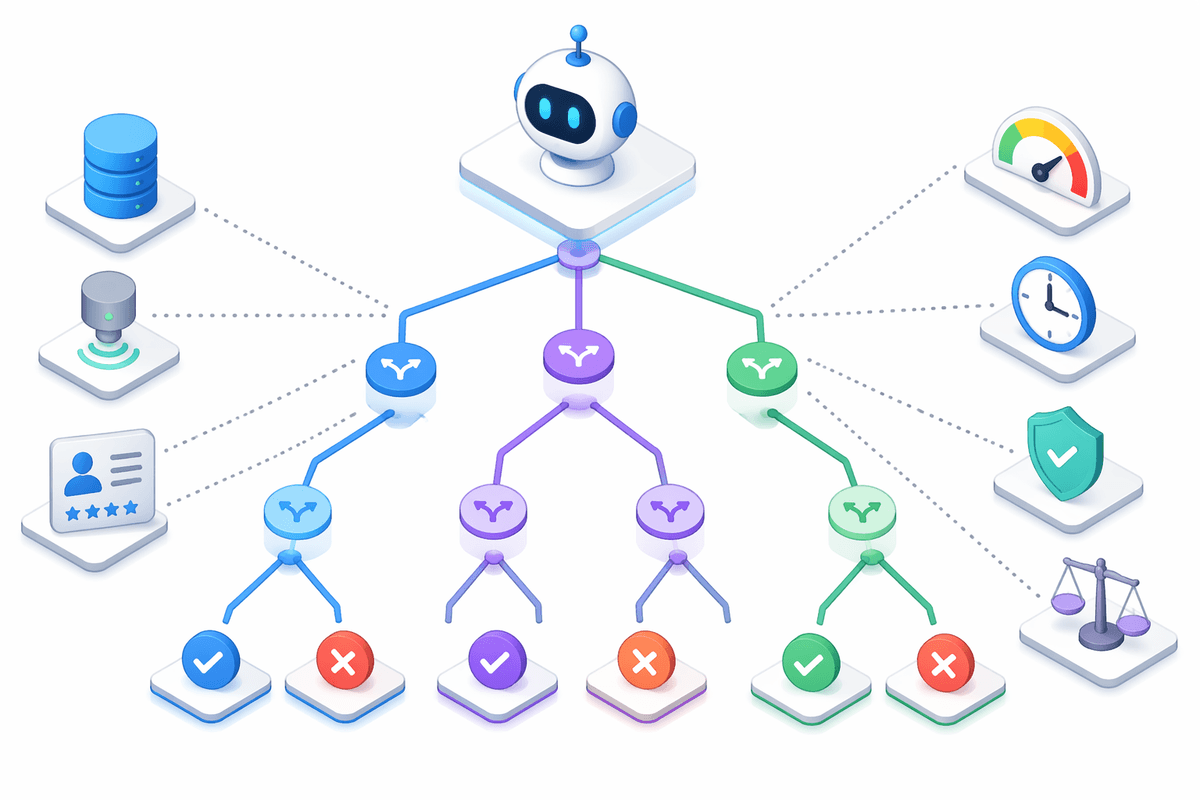
A practical starting point is to write down where the agent actually makes choices, not where you wish it did. List decision points (approve/deny, reorder quantity, escalate to human, select an investigation path), what information is available at each point, and what “good” means there (loss, SLA, safety margin, fairness policy). This turns “why did it do that?” into a bounded question tied to a specific action and timestamp.
Then map constraints as first-class objects: hard rules (legal thresholds, inventory caps, clinical protocols), soft preferences (customer experience, margin targets), and guardrails (rate limits, forbidden tools, required approvals). Many failures come from implicit constraints living only in tribal knowledge or downstream systems, so the agent learns workarounds instead of compliance.
Finally, document observability gaps: key variables you care about but only see through proxies, delayed labels, missing cohorts, or unlogged tool outputs. Closing gaps costs time—new logging, data contracts, privacy reviews—and it can add latency, but it’s usually cheaper than arguing over unverifiable narratives after an incident.
Explanation methods that work at different “levels” of the system
You can usually tell when a team is over-promising on explainability: they offer one artifact (a feature attribution plot, a chain-of-thought, a dashboard) to answer every stakeholder’s question. In practice, explanation methods work best when they match the “level” of the decision you mapped: local, mechanistic, or system-level, with different evidence requirements and different ways they can mislead.
For local justification, lean on contrastive explanations: “we chose A over B because X changed the score and Y violated a constraint.” That can be done with counterfactuals, per-decision sensitivity checks, or policy rule hits, but it only holds if the alternatives were actually feasible at that moment. For mechanistic trace, use structured logs: tool calls, retrieved documents, intermediate outputs, and timestamps. The value is reproducibility, but the cost is real—more instrumentation, longer latency, and a larger privacy/security footprint if traces include sensitive context.
For system justification, you need artifacts that survive governance: objective specs, reward components, constraint definitions, escalation paths, and offline “behavioral tests” that show the agent respects them across scenarios. This level rarely fits in a single narrative; it’s closer to a safety case, and it only stays valid if you treat it like a maintained product, not a one-time report.
When explanations break: non-stationarity, feedback, and gaming
A familiar failure mode is when yesterday’s explanation looks coherent, but today the same “reason” produces a different outcome. Non-stationarity shows up as new product mixes, policy changes, seasonality, vendor churn, or a quiet upstream feature shift. The agent’s logged rationale may still match its inputs, yet the mapping from inputs to real-world effects has moved, so the explanation no longer predicts behavior under review.
Feedback makes this worse because the agent changes what it later observes. Fraud models reduce certain fraud types, pricing changes demand composition, triage affects who returns for follow-up, and investigation agents influence which cases get labeled. Explanations that ignore these loops can be locally true but systemically misleading, especially when labels are delayed and monitoring only sees the “treated” population.
Gaming is the final crack: people and downstream services adapt to the explanation surface. If you expose simple rules or stable rationales, users learn what to satisfy, and the agent may learn to satisfy the explanation rather than the intent (e.g., hitting proxy metrics, cherry-picking evidence, or routing around constraints). Preventing this costs real effort: rotating tests, red-teaming, and keeping some checks private.
Design patterns for building explainable agents in practice
You often see the same pattern in production: the agent can answer, but no one can tell what it saw, what it assumed, or which constraints it considered. A reliable fix is to make “explanation” part of the interface contract. Every decision emits a compact decision record: inputs (with versions), candidate actions considered, constraint checks that passed/failed, and the objective terms that dominated. Treat it like an audit log you’d want during an incident, not a narrative you hope is persuasive.
Another pattern is to separate “acting” from “justifying.” Run the agent with a strict tool policy (allowed tools, rate limits, required citations), then generate the justification from the structured trace, not from free-form text. If you need language, produce it from templates over the record (“Rejected B due to policy P12; chose A because it reduced expected backlog by 8% under capacity cap”). The limitation is cost: richer traces mean more storage, higher latency, and more privacy/security review—especially if you log retrieved documents or user context.
Finally, bake explainability into failure handling. Use explicit uncertainty gates (low confidence → escalate), pre-registered “why” questions per decision type, and a small set of behavioral tests that run on every model or prompt change. The goal isn’t perfect transparency; it’s making the system inspectable enough that a reviewer can reproduce decisions, spot missing constraints, and decide when the agent should not act.
How to evaluate explanations without fooling yourself

A familiar trap is judging an explanation by how reasonable it sounds. Instead, treat it like a claim that must predict what would change the decision. Take a sample of real decisions, hide the outcome, and ask reviewers to use the explanation artifact to anticipate the agent’s next action under a small input change or a constrained alternative. If they can’t, you likely have a narrative, not an evaluable explanation.
Use three checks that fail in different ways: fidelity (does the explanation match the logged trace and the model’s actual dependencies), stability (does it stay consistent under harmless perturbations), and usefulness (does it help a human catch policy violations or unsafe edge cases faster). Each check needs a baseline: compare against a simple rule-based summary or a smaller model, and measure time-to-diagnose, not just agreement.
Budget for adversarial review. Explanations are a new surface for leakage and gaming, so run red-team cases where a user tries to elicit hidden prompts, bypass constraints, or force plausible-sounding citations. You’ll need rotation of test suites and re-validation after data, tool, or policy changes.
Choosing your next step: match risk level to explainability depth
A common choice point is whether you’re using the agent for decision support or for autonomous action. If it can only recommend, you can often start with local justification plus a minimal trace (inputs, versions, alternatives considered), then iterate. If it can execute actions that move money, access, or safety, require system-level artifacts: explicit objectives, non-bypassable constraints, escalation rules, and behavioral tests that run on every change.
Match depth to downside, not to ambition. Higher explainability usually means more logging, storage, privacy review, and latency, and it can increase gaming risk if you expose stable rules. A practical operating rule is: no autonomy without replayable decision records, drift monitoring tied to observability gaps, and a clear “stop the line” condition when constraints can’t be verified.